Renters’ Rights Act 2025England
The landlord register opens on 15 December 2026. Here is your deadline.
England’s Private Rented Sector Database, the Government’s ‘Register your rental property’ service, rolls out region by region until 14 November 2027. If you let a home here you register yourself and each let property, at £65 a property a year. And while a property that should be registered is not, a court cannot make a possession order for it.
- Service opens
- 15 Dec 2026
- West Midlands first
- Deadlines
- Mar to Nov 2027
- By the property’s region
- Fee
- £65 a year
- For each property
- Penalty
- Up to £40,000
- Where it is an offence
LetCompliance builds a register pack for each property from your records: the details the draft regulations ask for, with the certificate files ready to upload. From £7.99 a month, 3-day trial, no card.
Get startedYour deadline
PRS Database registration deadlines by region
Registration becomes a legal requirement one region at a time, and each region then has three months. The deadline follows where the property is, not where you live. You can register any property from 15 December 2026.
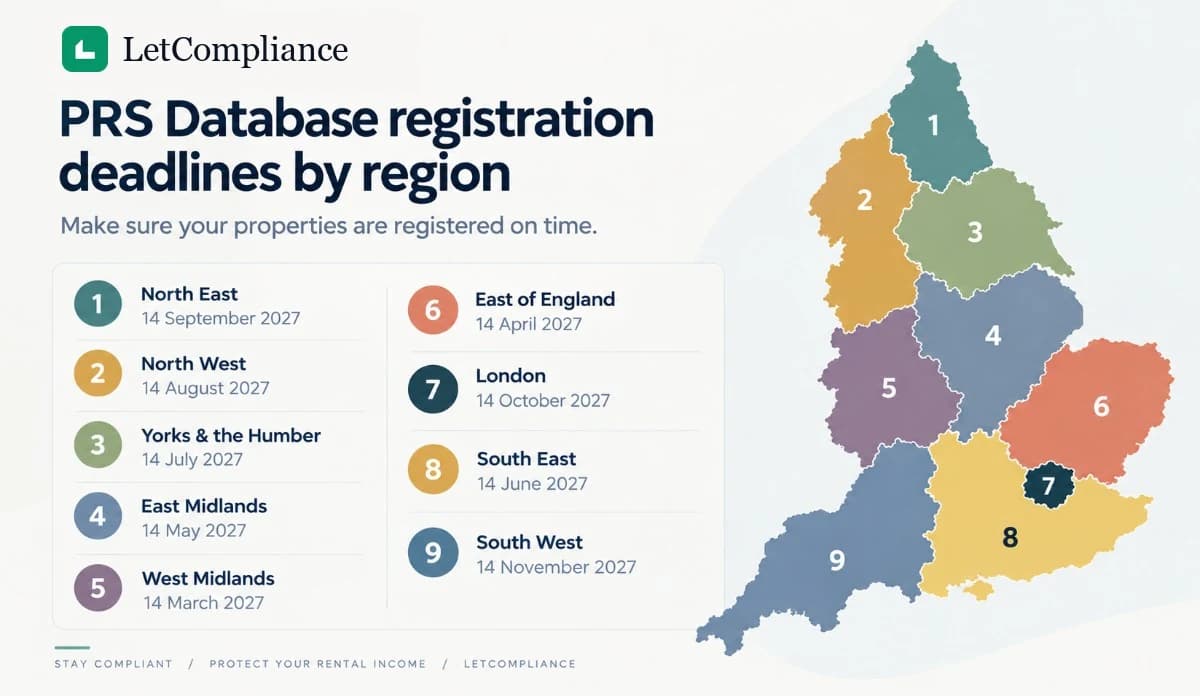
| Region | Required from | Deadline |
|---|---|---|
| West Midlands | 15 December 2026 | 14 March 2027 |
| East of England | 15 January 2027 | 14 April 2027 |
| East Midlands | 15 February 2027 | 14 May 2027 |
| South East | 15 March 2027 | 14 June 2027 |
| Yorkshire and the Humber | 15 April 2027 | 14 July 2027 |
| North West | 15 May 2027 | 14 August 2027 |
| North East | 15 June 2027 | 14 September 2027 |
| London | 15 July 2027 | 14 October 2027 |
| South West | 15 August 2027 | 14 November 2027 |
After a region’s deadline, councils there can start enforcement. For now only properties that are let, or become let during the rollout, need registering. Source: GOV.UK Housing Hub, checked 23 September 2026.
Find your date
Which deadline applies to a property? Put in its postcode.
Quick answer
Do landlords have to register on the PRS Database?
Yes.If you let a home in England on an assured or regulated tenancy, the Renters’ Rights Act 2025 requires you to register yourself and each let property on the Private Rented Sector Database. It opens on 15 December 2026, and each region has a deadline between 14 March and 14 November 2027. Registration costs £65 a property, per year. A council can impose a penalty of up to £7,000 for not registering, or up to £40,000 where it is an offence, and while you are in breach a court cannot make a possession order except on antisocial behaviour Grounds 7A and 14.
Sources: GOV.UK Housing Hub, GOV.UK news (9 September 2026) and the Renters’ Rights Act 2025, sections 82 and 90 to 92, checked 23 September 2026.
Free reminder
Get PRS Database updates by email
The Government will publish guidance on using the service before it opens on 15 December 2026. Leave your email and area and we will send you the updates that matter for your deadline.
One address, used for this reminder only. Unsubscribe in one click.
In plain English
What the PRS Database is, and how registration works
A national register of landlords and the homes they let, and the first one in England that the law requires. It sits alongside selective and HMO licensing and the future Landlord Ombudsman; registering does not replace a licence, and a licence does not replace registering.
- 01
Register yourself once
Sign in with a GOV.UK One Login and add your details as the landlord, whether you let one property or fifty.
- 02
Add each let property
Each property gets its own entry with its tenancy, rent and safety certificates, and costs £65 a year.
- 03
Renew and keep it current
Registration is renewed every year. Councils use the register for enforcement, and tenants will be able to check it in future.
What you will need
What information do you need to register a rental property?
The Government has published the list, and none of it is unusual: it is the paperwork a well-run let already has. Organisations that let property give more, such as company and director details.
You and the property
- Your name, date of birth, address, phone and email
- Property address, ownership type and dwelling type
- Number of bedrooms, and whether it is let
- Freeholder, superior landlord or property manager, if any
The tenancy and rent
- Number of occupants and households
- HMO, additional or selective licence, and its number
- Furnished, part furnished or unfurnished
- Rent, how often it is paid, and any utilities included
Safety records
- A copy of the gas safety record and its issue date
- A copy of the EICR (or EIC) and its expiry date
- A copy of the EPC where one was due, and any registered exemption if it is below the minimum rating
More than one property
How to register more than one property
You register yourself once as a landlord, then add each property you let as its own entry. The Government has published the draft regulations that set out how the register works, and for a portfolio six rules matter most.
One entry per property, each with its fee
You register yourself once, then give every let property its own entry at £65 a year. Ten properties come to £650 a year.
Draft regulations 5 and 6; fee as published by the Government
One renewal date for the whole portfolio
Each entry lasts a year. Once your first property is registered, every property you add afterwards renews on the same date, so a portfolio renews once rather than property by property.
Draft regulation 10(4) and (5)
Each property keeps its own deadline
The deadline follows the property, not you. A flat in Birmingham is due by 14 March 2027, a house in Leeds by 14 July 2027.
The regional rollout the Government published
28 days to complete each entry
For a property that is let, the tenancy and safety details (occupants, rent, the gas safety record, EICR and EPC) must follow within 28 days of the entry, or it becomes inactive. The law requires an active entry for every let property.
Draft regulations 6(2), 9 and 11(2)
28 days to report a change
A new tenant, a renewed gas safety record or a rent rise has to reach the register within 28 days of the old details going out of date. Across a portfolio, that is a steady flow of small updates.
Draft regulations 8 and 9(4)
Joint owners and agents
Joint landlords each make their own landlord entry and share one entry per property. A letting agent or property manager can add the tenancy and safety details for you, but the duty stays with the landlord.
Draft regulations 4(5) and 7
Source: the draft Private Rented Sector Database Regulations 2026 and their explanatory memorandum on legislation.gov.uk. They are a draft and not yet in force. The Government will publish guidance before the service opens, and this page will follow it.
Timeline
From December 2026 to November 2027
The service opens on 15 December 2026 in the West Midlands. Each region then has three months, and the last deadline, in the South West, is 14 November 2027. Empty properties do not need registering yet: later legislation will require it before they are marketed.
Penalties
Up to £7,000, or £40,000 for an offence
A council can impose a penalty of up to £7,000 for breaching the registration requirements, or up to £40,000 where the breach is an offence: giving false or misleading information, carrying on after a penalty, or a further breach within five years. On top of that, the possession block above applies.
Get ahead of it
How to be ready before your deadline
When a region’s deadline comes, many landlords will be digging through emails for gas certificates and EPC dates. LetCompliance already holds your addresses, bedrooms, furnished status, tenants, rent and safety records for each property, so registering works from a checklist rather than a search.
- Bring a whole portfolio in from one spreadsheet, certificate dates included
- A readiness score from 0 to 100 for each property, against the particulars the register asks for
- The registration deadline for each property’s region
- Checks for address, dwelling type, bedrooms, furnished status and licensing
- Your gas safety record, EICR and EPC taken from your compliance records
- Flags a likely missing HMO licence, and records rooms and households
- Records each property’s registration status, reference and date once you have registered
On the calendar
Making Tax Digital and the PRS Database: when each applies
Opens
PRS Database registration
The ‘Register your rental property’ service (the PRS Database) opens on 15 December 2026 for landlords who let homes in England, region by region: each region has three months from its start date, the last deadline is 14 November 2027, and the fee is £65 a year per property.
- What to do now
- Find each property’s deadline from its postcode, and have a copy of its gas safety record, EICR and EPC ready to upload.
- In LetCompliance
- On every plan, LetCompliance finds each property’s deadline from its postcode, fills in its register pack from your records with the certificate files to upload, and emails you 30 and 7 days before the deadline until the property is marked registered.
Starts
Making Tax Digital for income over £30,000
Making Tax Digital for Income Tax applies from 6 April 2027 to landlords whose qualifying income was over £30,000 in the 2025 to 2026 tax year; it has applied since 6 April 2026 where that income was over £50,000 in the 2024 to 2025 tax year.
- What to do now
- Add up your share of the rent, and any self-employment turnover, for the 2025 to 2026 tax year before expenses: over £30,000 means digital records and quarterly updates from 6 April 2027.
- In LetCompliance
- LetCompliance is recognised by HMRC for Making Tax Digital and sends the quarterly updates for UK property income from the rent and expenses you already record, in every paid plan from £7.99 a month.
Dates from GOV.UK’s Making Tax Digital guidance and the GOV.UK Housing Hub, checked 26 September 2026.
Questions
PRS Database registration: FAQ
Do landlords have to register on the PRS Database?
Yes, if you let a home in England on an assured or regulated tenancy. The Renters’ Rights Act 2025 creates the Private Rented Sector Database, which the Government runs as the ‘Register your rental property’ service. You register yourself and each property you let. Landlords of supported exempt accommodation under the Supported Housing (Regulatory Oversight) Act 2023 do not need to register.
When does the PRS Database open?
The service opens on 15 December 2026, starting in the West Midlands. Registration then becomes a legal requirement one region at a time, a month apart, and each region has three months to register. The last deadline is 14 November 2027. You can register any property from 15 December 2026, before your own region’s deadline.
What is my PRS Database registration deadline?
It depends on where the property is, not where you live: a London landlord with a flat in Birmingham works to the West Midlands deadline. The deadlines are West Midlands: 14 March 2027; East of England: 14 April 2027; East Midlands: 14 May 2027; South East: 14 June 2027; Yorkshire and the Humber: 14 July 2027; North West: 14 August 2027; North East: 14 September 2027; London: 14 October 2027; South West: 14 November 2027. After a region’s deadline, councils there can start enforcement.
How do I register on the PRS Database?
Online, through the ‘Register your rental property’ service, from 15 December 2026. You sign in with a GOV.UK One Login, add your details as the landlord, then add each property you let with its tenancy, rent and safety certificates, and pay the fee for each property. Registration is renewed every year. There will be an offline route for landlords who need one, and a contact centre for help.
What information do I need to register a property?
Your name, date of birth, residential address, phone number and email. For each property: the address, ownership type, dwelling type, number of bedrooms, whether it is let, and the name and email of any freeholder, superior landlord or property manager. The tenancy: number of occupants and households, any HMO, additional or selective licence and its number, and whether it is furnished. The rent and how often it is paid, and whether it includes utilities. And the safety records: the gas safety record and its issue date, the EICR and its expiry date, and the EPC where one had to be given to the tenant.
How much does it cost to register on the PRS Database?
£65 a year for each property, and you renew each year. The fee is per property, so three properties cost £195 a year. During the rollout the fee is pro-rated, so landlords who register first do not pay more.
What is the penalty for not registering on the PRS Database?
A council can impose a financial penalty of up to £7,000 for breaching the registration requirements, or up to £40,000 where the breach is an offence: knowingly or recklessly giving false or misleading information, carrying on more than 28 days after a penalty, or a further breach within five years of one (Renters’ Rights Act 2025, sections 91 and 92). And while you are in breach of the duty to be registered, a court cannot make a possession order for that property except on the antisocial behaviour Grounds 7A and 14 (section 90).
Do I register the landlord or each property?
Both. You register yourself once as the landlord, then add a record for every property you let, and each property carries its own £65 annual fee.
Do all my properties renew on different dates?
No. Under the draft regulations, entries last a year, and once your first property is registered every property you add afterwards takes the same renewal date, so a portfolio renews once a year. Each property still pays its own £65.
What happens if I do not finish a property’s entry?
For a property that is let, the draft regulations give you 28 days from creating the entry to add the tenancy and safety details: occupants and households, rent, the gas safety record, the EICR and the EPC. If they are not added, the entry becomes inactive, and the law requires an active entry for every let property. Changes, such as a new tenant or a renewed certificate, also have to be updated within 28 days.
Do I still need to register if I use a letting agent?
Yes. The landlord has to start and end the registration. Your letting agent or property manager can upload certain information for you, and the Government will publish guidance for agents before launch, but you remain responsible for providing everything required. Agree in writing who is doing what.
Do I need to register an empty property?
Not yet. For now you only have to register properties that are let, or become let during the rollout. Later legislation will require you to register an unoccupied property before you or your agent market it, and to show your landlord and property identifiers on adverts. The Government will publish guidance before that applies.
Who can see the PRS Database, is it public?
Councils will use it for enforcement. In future, tenants will be able to use the service to check whether a landlord meets key legal requirements. The Government has said it will publish the list of information the public can see at a later stage, balancing landlords’ privacy with what tenants need to know.
Is the PRS Database the same as selective licensing? Do I need both?
No, and you can need both. Selective and HMO licensing are local council schemes covering specific areas or property types. The PRS Database is a single national register under the Renters’ Rights Act 2025 for rented homes in England, on top of any licence you already need, and it asks for your licence numbers. The housing minister confirmed to Parliament that the database is not designed to replace selective licensing: the two do different jobs. Registering does not discharge a licensing requirement, and holding a licence does not exempt you from registering. They cost differently too: the register is £65 a property a year, while a selective licence fee is set by each council.
How does LetCompliance help me get PRS-ready?
Most of what the register asks for is already in your account: addresses, dwelling type, bedrooms, furnished status, licensing, tenants, rent and your gas safety, EICR and EPC records. The PRS Database page scores each property 0 to 100 against those particulars, shows the deadline for its region, flags what is missing, and records each property’s registration status, reference and date once you have registered.
Related
- PRS Database: the full guide
- Selective licence fees by council
- Renters’ Rights Act 2025
- Section 8 possession notice
- PRS Database readiness checker
- UK landlord regulations
General information, not legal advice. Dates, fee and the information list are from the Government’s Housing Hub, checked 23 September 2026. Check GOV.UK before you register. LetCompliance is landlord software for England.

