Know the risk, with the reasons. The Tenant Risk Report, for UK landlords
A credit risk analyst reads your applicant’s income, bank statements and references, grades the risk low, medium or high and gives a straight recommendation. It is £79 a report, or £149 with the guarantor assessed too, for UK landlords on every plan.
£79 a report, paid once. Signing up needs no card.

How to order a tenant risk report. The Tenant Risk Report, from the applicant’s papers to the grade
From inside your account, on any plan, one applicant at a time. Each report is paid when you order it.
Choose the report
The Tenant Risk Report, £79, reads the income, the affordability against the actual rent and the references you hold. The in-depth review, £149, adds a full financial picture and the guarantor.

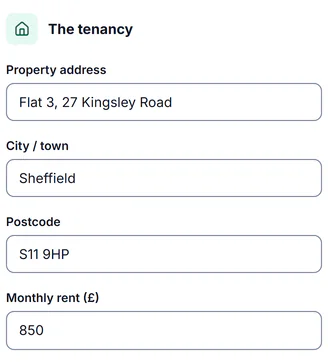
Sample account with made-up details, 19 Oct 2026 Add the let and the applicant
The address and the monthly rent, then the applicant’s name, their work, their email and phone, and whether there is a guarantor.
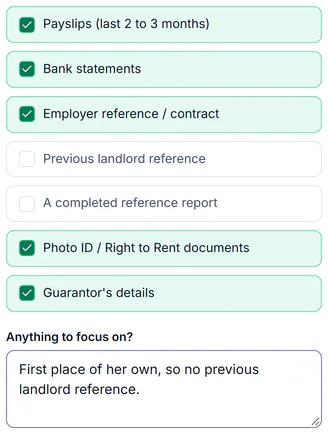
Sample account with made-up details, 19 Oct 2026 Tick what you can send
Payslips, bank statements, an employer or landlord reference, a reference report you already have, ID and the guarantor’s details, with a line on anything to focus on.
Sample account with made-up details, 19 Oct 2026 Pay, then send the documents
Card payment by Stripe, with an invoice by email. A secure request for the documents follows, and the written report and recommendation come back within a couple of working days of them arriving.


Your reports are listed on the same page, each marked Requested, In review or Completed as it moves.
What you no longer guess at before you let. What a tenant risk report changes before you let
3 grades: low, medium or high. A reference tells you whether the applicant cleared a bar. The report grades the risk, writes out why, and ends on a straight recommendation: accept, accept with conditions, or decline.
Before Reading the payslips on your own
Now A credit risk analyst reads the income the way a lender would: what arrives each month, how secure the work is, and whether the payslips agree with the bank statements and with what the applicant told you.
Before Taking the guarantor on trust
Now The in-depth review, £149, assesses the guarantor the same way as the tenant, builds a full financial picture from the bank statements and suggests conditions worth putting on the tenancy.
Before A decision with nothing written down
Now Every report ends on a recommendation with its reasons, counting benefit income like any other income, so you can see why. The decision to let stays yours.
Everything it does. The Tenant Risk Report, feature by feature
- The Tenant Risk Report, £79: the income, the affordability against the actual rent and the references you hold
- The in-depth tenant and guarantor review, £149: a full financial picture from the bank statements, the guarantor assessed the same way
- Read and written by a qualified credit risk analyst, not an automated pass
- A risk grade, low, medium or high, with the reasons written out
- A straight recommendation: accept, accept with conditions such as a guarantor, or decline
- Benefit income counted like any other income
- Self-employed income read from the accounts and the bank statements together
- Whatever you hold: payslips, bank statements, references, a reference report, ID and Right to Rent documents
- A line on anything you want the analyst to focus on
- Paid once by card through Stripe, with an invoice by email and no VAT added
- A secure request for the documents, and the report usually within a couple of working days
- Each report marked Requested, In review or Completed as it moves
- All of England, done remotely from the documents
- A credit-backed reference first if you want one, with tenant referencing, from £24.99
- Applicants with their income, work, guarantor and Right to Rent asked up front, in applications and viewings
- The agreement drafted from the same tenancy and e-signed
- Rent by Direct Debit, and the arrears on the tenancy if it comes to that
- Not a search of a credit file, and never the decision: the choice stays yours
The report is one step of the let. The rest is in the same login. How the report sits with the rest of the let
Applications and viewings
Applicants apply from your own link or listing, with their income, work, guarantor and Right to Rent status asked up front, and every one of them is on one list.
Credit-backed referencing
A full reference checks credit, affordability, the employer and the current landlord through a regulated UK credit reference agency, for £24.99. The report can then read what it found.
Rent, and arrears if it comes to that
Rent is collected by Direct Debit into your own Stripe account, with no commission. If a tenant falls behind, the arrears show on the tenancy with polite reminder emails once you switch them on. Stripe charges 1% of each Direct Debit payment with a 20p minimum and a £4 cap, and £5 for a disputed payment.
£79 a report, paid once. The Tenant Risk Report, paid once
The Tenant Risk Report is £79 and the in-depth tenant and guarantor review £149, each paid once by card, with no VAT added, on every plan. The rest of the let is priced by portfolio size, from £7.99 a month.
Want a credit-backed check as well? A full tenant reference is £24.99, and can be ordered on its own. Order one reference without an account
Questions, answered. The report, checking an applicant and ordering
What is a tenant risk report?
A credit risk analyst’s written read of a prospective tenant. It looks at their income and how stable it is, the rent against it, and the references and documents you hold, then grades the risk low, medium or high, with the reasons and a recommendation. In LetCompliance it is £79 a report.
Who actually reviews my applicant?
A qualified credit risk analyst who assesses affordability and default risk for a living. Every report is read and written by that person, not produced by an automated pass or fail.
How is this different from a normal tenant reference?
A reference checks the applicant against a threshold and tells you whether they passed. The report reads the income the way a lender would, weighs the references you hold and explains how much risk there really is. It can be ordered alongside a credit-backed reference rather than instead of one.
Do you run a credit check?
No. The report is an independent affordability and risk assessment of the documents and references you provide, not a search of a credit file. A credit-backed check through a regulated UK credit reference agency is a separate order in the same account, from £12.99.
How much is it?
£79 for the Tenant Risk Report, or £149 for the in-depth review, which adds a full financial picture from the bank statements and an assessment of the guarantor. Each is paid once by card, with an invoice by email and no VAT added.
What documents do you need from me?
Whatever you hold: payslips, bank statements, an employer reference or contract, a previous landlord reference, a reference report you already have, ID and Right to Rent documents, and the guarantor’s details. A secure request for them arrives by email after payment.
How long does the report take?
Usually a couple of working days from the point your documents arrive. If you are up against a date, say so in the notes when you order and the analyst will try to turn it round sooner.
What does the risk grade actually mean?
Low, medium or high, with the reasons written out plainly, and a recommendation: accept, accept with conditions such as a guarantor, or decline. It is written to be acted on, not filed away.
Is it worth it if they’ve already passed referencing?
Often, yes. A pass means they cleared a threshold; it does not say how much room the rent leaves them, or what to do if it is tight. A tenant who stops paying is now slower and costlier to move on, so an expert read before you sign is cheap by comparison.
Can you assess a self-employed applicant?
Yes. With no payslip to read, self-employed income is harder to judge. The analyst reads the accounts and the bank statements together and says what the applicant can realistically sustain.
What about a student, or someone on benefits?
Both can be good tenants, and both need reading properly: for a student, the guarantor and any funding behind them; for benefit or mixed income, what is stable and what the rent leaves. Benefit income counts like any other, and nobody is marked down for claiming benefits.
Can you spot fake payslips and forged documents?
Not by forensics, and the report does not claim to: no document verification technology is used. The analyst reads the whole file together. A generated payslip can look right alone, but it is much harder to make it agree with the bank statements, the work history and what the applicant told you.
How do I know if an applicant is lying about their income?
Cross-check, and trust the bank statements over the payslip. The tells are usually arithmetic: net pay that does not match the deductions shown, round-number credits, a salary landing on a different date each month, or an employer too small for the wage.
What are the warning signs of a problem tenant?
The reliable signs are in the paperwork, not the person: payslips that do not reconcile with the bank statements, a deposit offered from someone else’s account, reluctance to name a current landlord, gaps in the address history, and pressure to move in before the checks finish. None proves anything alone; two or three together is when a second look for £79 is worth having.
What checks should a landlord do before letting a property?
Four, and they are separate. Right to Rent, a legal duty for every adult aged 18 or over before the tenancy starts. Affordability, by a common rule of thumb a yearly income of about 30 times the monthly rent. Credit, for county court judgments and insolvencies. And a reference from the previous landlord.
Can a landlord do a background check on a tenant?
Yes, within limits. In England the law requires a Right to Rent check, and with the applicant’s agreement a credit-backed reference checks their credit, income, employer and current landlord. A Tenant Risk Report then reads that evidence together. Neither is a criminal record check.
Can I refuse a tenant because they receive benefits or have children?
No. Since 1 May 2026 it is unlawful in England to turn someone away, or to apply a rule that makes renting less likely for them, because they claim benefits or a child would live with them. You may still weigh income against the rent, with the same requirement for everyone and benefit income counted like any other.
What should I do if my applicant fails referencing?
Treat a fail as information. Ask for a guarantor, referenced to the same standard and typically earning about 36 times the monthly rent; take a deposit up to the legal cap of five weeks’ rent, or six where the annual rent is £50,000 or more; or decline. Rent in advance can no longer bridge the gap, as none may be taken before the tenancy is entered into.
How do I check a guarantor properly?
To the same standard as the tenant: their own income evidence and credit check, ideally with a home they own. Say in the deed whether they guarantee the whole rent or one sharer’s share, have it properly executed, and note that a guarantee given since 1 May 2026 does not cover rent after the tenant’s death.
What areas do you cover?
All of England. The report is remote and works from the documents, so where the property is makes no difference.
Does this decide who I let to?
No. The final decision is always yours. The report gives you a clear, evidenced view of the risk so you can make it with your eyes open.
Do I need a LetCompliance account?
Yes. The report is ordered and paid for from inside a LetCompliance account, on every plan, so the order and its progress stay in one place. Signing up needs no card.
In depth. What a tenant risk report reads, and how to check a tenant in the UK
What a tenant risk report reads
A tenant risk report reads an applicant the way a lender would: what lands in their account each month, how secure the work behind it is, and whether the papers agree. A pass or a fail says what has happened; the report says how likely the rent is to keep coming.
Affordability, done properly
What actually arrives each month against the rent and their other commitments, not a rent multiple.
How solid the income really is
A permanent salary and a three-month contract can show the same figure and carry very different risk.
The self-employed picture
The accounts and the bank statements read together, for what can genuinely be sustained.
References, read for what they’re worth
Which parts of the references you hold to lean on, and which to take lightly.
The guarantor, in the in-depth review
Assessed the same way as the tenant, so the backing is real money, not just a name on a form.
The things that are easy to miss
Gaps in the history, a run of recent moves, income that does not quite add up.
Documents that don’t hang together
No forensic checks are made, but a forged payslip still has to agree with the bank statements; the guide to spotting fake references and payslips shows the usual tells.

What it is not: a search of a credit file, or a decision made for you. The choice stays yours.
How to check a tenant in the UK
To check a tenant in the UK, ask for their details up front, check their right to rent, order a credit-backed reference, then have the evidence read together before anything is signed. Judge every applicant on the same terms, and keep the reasons for your decision.
Ask for the details up front
Income, work, a guarantor and Right to Rent status, asked before the viewing; the rent affordability calculator shows whether the income covers the rent.
Check the right to rent
Every tenant aged 18 or over, before the tenancy starts. The Right to Rent check wizard walks through which documents count.
Order a credit-backed reference
A full reference, £24.99, checks credit, affordability, the employer and the current landlord. With no previous landlord, as with a first home, the options when there is no reference include a guarantor.
Have the evidence read together
When the result leaves you unsure, a Tenant Risk Report, £79, has a credit risk analyst read it all together and grade the risk, with the reasons.
Decide, and keep the reasons
Accept, accept with conditions or decline, on the same terms for every applicant.

Tenant check rules in England, in brief
What you must check, what you may not do, and what changed on 1 May 2026, each with its source.
Check the right to rent first
Every tenant aged 18 or over must have the right to rent in England, checked before a new tenancy starts.
Source: GOV.UK, Check your tenant’s right to rent (opens in a new tab)
Judge the income, never the category
Nobody may be turned away for having children or claiming benefits. Income can still be weighed against the rent, with one requirement for everyone; the guide to screening tenants within the law has worked examples.
Sources: Renters’ Rights Act 2025, section 33 (opens in a new tab), section 34 (opens in a new tab) and GOV.UK, Rental discrimination guidance (opens in a new tab)
The tenant never pays for the checks
A tenant may only be asked for the payments the Tenant Fees Act permits. A fee for a reference, a credit check or a risk report is not one of them.
Source: Tenant Fees Act 2019, section 3 and Schedule 1 (opens in a new tab)
No rent before the tenancy is signed
No rent for an assured tenancy may be taken before the tenancy is entered into, so a large sum up front can no longer cover a weak application. The rent in advance rules are set out in full.
Sources: Renters’ Rights Act 2025, section 9 (opens in a new tab) and section 8 (opens in a new tab)
A deposit has a ceiling
At most five weeks’ rent, or six weeks’ where the annual rent is £50,000 or more. Anything above the cap is a prohibited payment.
Source: Tenant Fees Act 2019, Schedule 1, paragraph 2 (opens in a new tab)
A guarantee ends with the tenant’s death
A guarantee given since 1 May 2026 does not cover rent from the tenant’s death; a deed of guarantee drafted since then should say so.
This is not legal advice. The longer guide to tenant referencing covers what a reference finds and what it misses.
Know the risk before you sign.
Order a Tenant Risk Report from your account and get an expert read on your applicant, with the reasons written down, from £79.

